Hendi Serving Trolleys
Hendi Serving Trolleys. Hendi catalogue from SIA La RONDE
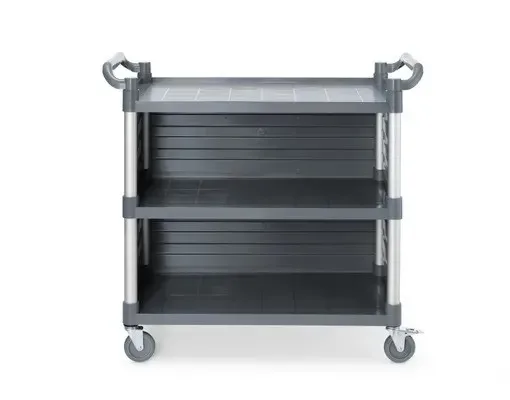
Serving trolleys help hospitality teams move dishes, service items and supplies between preparation areas, dining spaces and collection points. For a restaurant, hotel or catering operation, a trolley can reduce repeated carrying and keep a service run organised. This model has side panels and two shelves, giving staff a mobile surface for staging items before a run and returning them afterwards. Its practical value depends on matching the trolley’s footprint, shelf layout and load limits to the work being done.
Equipment and tasks
Use a serving trolley to transfer tableware, condiments, clean service items or cleared dishes as part of routine front-of-house work. A dedicated trolley lets staff group items for a particular task, rather than making several separate journeys by hand. The side panels provide boundaries alongside the shelves as the trolley is moved, while the two-level arrangement separates items or creates room for a return load. It can also serve as a temporary staging point near a service area, keeping items together while staff work through a sequence of tasks.
The four swivel castors support changes of direction along working routes, and two have brakes to hold the trolley in place while staff load or unload it. Rounded corners make close handling more comfortable around people and furniture. These details are useful during busy service, when operators may need to manoeuvre a loaded trolley into position, stop it for access, then move it on without rearranging the whole working area.
Parameters in use
The overall dimensions are 1010 × 500 × 960 mm. The length and width help teams assess its footprint along the planned route and at the point where it will be parked for loading. The height gives a reference for handling and positioning the trolley during service. Its shelf surface measures 842 × 486 mm, helping staff judge how to arrange plates, trays or supplies across each level. The 308 mm distance between shelves is the vertical clearance to consider when choosing items for the lower level.
Each shelf has a maximum load capacity of 50 kg. Staff can use this limit when dividing a load between levels, keeping heavier service items within the capacity of the shelf carrying them. The material is PP (polypropylene), a lightweight plastic commonly suited to wipe-clean equipment. This helps make routine cleaning and repositioning manageable between tasks. The trolley weighs 11.85 kg, giving staff a concrete reference when considering its handling before adding the items required for a service run.
Choosing a product
Start by considering the work pattern: whether the trolley will mainly carry clean items to service, collect used dishes, or support both tasks at different points in a shift. Decide what needs to travel together, then compare those items with the shelf surface and the clearance between levels. Separate clean and collected items where the workflow requires it, and distribute the load so that neither shelf exceeds its 50 kg capacity. This turns the trolley’s dimensions and limits into practical checks for the intended load, rather than abstract measurements.
Next, consider the route and stopping points. Compare the trolley’s 1010 × 500 × 960 mm footprint with the spaces it must pass through and the areas where staff will load, unload or park it. Swivel castors and brakes are relevant when the route includes turns and when the trolley needs to remain stationary during access. Polypropylene construction is useful where staff value lighter handling and straightforward wipe-clean care. Select the trolley according to the items it must carry, the clearance they need and the way staff move through service, so it supports a defined task rather than becoming an unplanned storage surface.