Hendi Universal Polypropylene Serving Trolleys
Hendi Universal Polypropylene Serving Trolleys. Hendi catalogue from SIA La RONDE
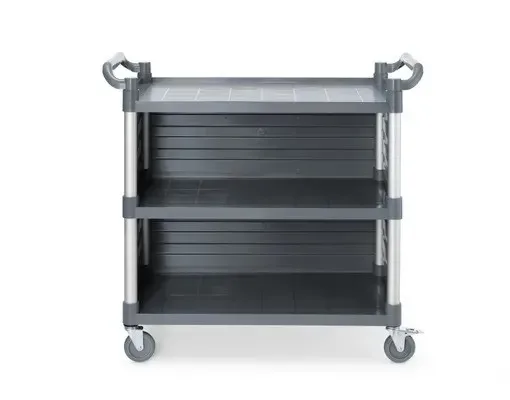
In a busy hospitality operation, a serving trolley helps staff move dishes, serviceware and other working items between preparation, service and clearing areas. This polypropylene model has side panels and two shelves, giving teams surfaces to organise a load for a particular task. It can support service runs in restaurants, hotels and catering settings, where staff need to move equipment around a working area rather than carry each item separately. Consider the route, the load and the point where the trolley will be used when assessing its suitability.
Equipment and tasks
Use the shelves to separate items by task, keeping frequently needed serviceware accessible while carrying additional items below. The upper shelf is positioned at an ergonomic height for convenient use, so staff can place or retrieve items without working from the lower level. Side panels help define the carrying area, while two shelves provide separate surfaces for organising a run. This arrangement can be useful when teams need to move several groups of items between work areas.
Four swivel wheels allow the trolley to turn as staff guide it through a route. Two wheels have brakes, helping hold the trolley in place during loading or unloading. It is described as easy to move over uneven surfaces and convenient to use in lifts and narrow corridors, which may be relevant when a service route passes between different parts of an operation. Rounded corners support safer, more comfortable handling when staff work close to the trolley.
Parameters in use
The overall dimensions are 1010 × 500 × 960 mm. Use them to assess the trolley’s footprint and height against the available route and position. Each shelf measures 842 × 486 mm, helping teams judge how plates, serviceware or other items can be arranged across its surface. The 308 mm gap between shelves gives a practical check on whether items intended for the lower shelf will fit beneath the upper one.
Each shelf has a maximum load capacity of 50 kg. Staff can use this per-shelf limit when dividing a load, keeping the weight on each surface within its capacity. The trolley is made from PP (polypropylene), a lightweight plastic that helps keep it manageable to reposition during work. Its weight is 11.85 kg, a useful consideration when planning how it will be handled between service tasks.
Choosing a product
Start by matching the shelf area to the equipment and items that need to travel together. The shelf measurements help with planning the arrangement, while the clearance between shelves helps establish whether lower-level items will fit. For a task involving heavier loads, distribute items with the capacity of each individual shelf in mind. Organising items by destination or stage of service can make it easier for staff to handle a trolley load efficiently.
Then consider how the trolley will move and where it will pause. Swivel wheels support changes of direction, while the brakes help keep the trolley stationary for loading or unloading. Its described use on uneven surfaces and in lifts and narrow corridors may suit operations with those route conditions. Side panels, rounded corners and the ergonomic height of the upper shelf also contribute to day-to-day handling. Compare these working characteristics with the requirements of the intended service task.